Buy rehazentrum.eu ?
We are moving the project
rehazentrum.eu .
Are you interested in purchasing the domain
rehazentrum.eu ?
domain@kv-gmbh.de · 0541-91531010
Buy rehazentrum.eu ?
Is a 12-year-old Chianti still drinkable?
Yes, a 12-year-old Chianti can still be drinkable, especially if it has been stored properly in a cool, dark place. Chianti is a red wine that is known for its aging potential, and many Chianti wines can continue to develop and improve in flavor over time. However, it's important to note that not all Chianti wines are meant for long-term aging, so it's best to consult with a wine expert or sommelier to determine if a specific bottle of Chianti is still drinkable after 12 years. **
What are your tips for the German Classico?
To enjoy the German Classico, make sure to immerse yourself in the rich history and intense rivalry between Bayern Munich and Borussia Dortmund. Learn about the key players on both teams and their playing styles to appreciate the tactical battle on the field. Additionally, try to watch the match with friends or fellow fans to enhance the experience with lively discussions and friendly banter. Lastly, don't forget to savor the passion and excitement of one of the most anticipated matches in German football. **

Similar search terms for Chianti-Classico-Riserva-Ser
Top-Angebote
Products related to Chianti-Classico-Riserva-Ser:
-
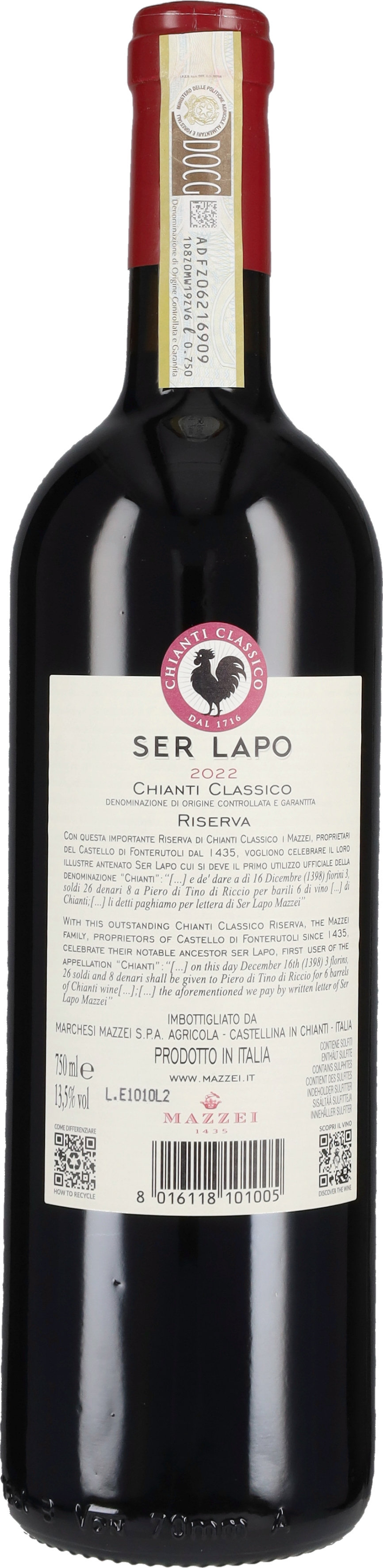
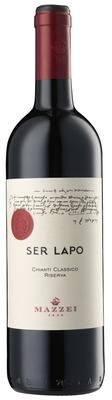
"""Mazzei Chianti Classico Riserva Ser Lapo 2021 Red Wine - Italy""""""Fresh, tannic, with aroma of berries, strong structure, earthy and intense taste. Blend: 90% Sangiovese, 10% Merlot A solid, well-shaped, focused and vibrant riserva with aromas of wild currants, Morello cherries, warm herbs and baking spices. It’s..."32,97 $*Shipping: 0,00 $Secure redirect to the provider
-
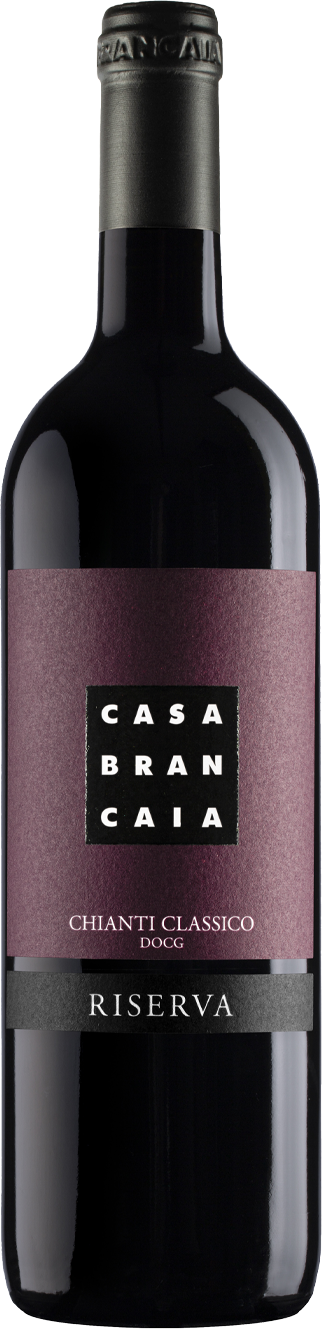
Chianti Classico Riserva Brancaia 2022The Chianti Classico Riserva by Brancaia is configured as an elegant and deep interpretation produced with the best Sangiovese grapes cultivated by the estate, to which a smaller percentage of Merlot is added, a variety that brings body and softness. This label, released for the first time with the 1982 vintage, is made in the estates of Castellina in Chianti and Radda in Chianti, historic municipalities of the Gallo Nero. Brancaia Chianti Classico Riserva originates from a blend of Sangiovese (80%) and Merlot (20%), varieties grown on medium-textured soils rich in skeleton, between 230 and 400 meters above sea level. The rows, exposed to the south and southwest, benefit from the characteristic continental climate with cold winters and hot summers. Once the grapes have reached their respective optimal ripeness, manual harvesting is carried out, followed by alcoholic fermentation in stainless steel tanks, separated for the two varieties, with about 20 days of maceration on the skins. Subsequently, the mass of Sangiovese matures in tonneau while the Merlot ages in barrique, all for a period of 16 months that precedes the blending and the further resting of 8 months in the bottle. In the glass, the Chianti Classico Riserva Brancaia displays an intense and bright ruby red cloak. Vivid and complex is the olfactory range, defined by aromas of red fruits, wildflowers, aromatic herbs, tilled earth, and tar that meet seductive perceptions of leather and vanilla. Intense, soft, and elegant taste development, with sweet and ripe tannins that lead to a fresh and flavorful epilogue. A Chianti Classico endowed with exceptional longevity, which needs to be paired with dishes of a certain structure such as rich preparations based on red meat or game.28,00 £*Shipping: 48,00 £Secure redirect to the provider
-
Chianti Classico Riserva Riecine 2022The Chianti Classico Riserva from Riecine is an elegant and intense version of this extraordinary Tuscan wine. It is the perfect synthesis between the beautiful hilly area of Gaiole in Chianti and Sangiovese: the red grape variety that has dwelled in these lands for centuries and is its authentic and best interpreter. It is a label of particular value, positioned in the elite of the denomination. The high-quality grapes and aging in wood contribute to give a mature and harmonious face, capable of preserving intact the fragrance and immediacy of the classic fruity notes of Sangiovese. The Chianti Riserva Classico wine is born in one of the most interesting and renowned wineries in the Classic Chianti area. Riecine has been a reference point for the reds of Gaiole for over 40 years, for its ability to produce labels that are not only of excellent quality but also faithful expressions of the character of the territory. The vineyards cover a total of about fifteen hectares, divided into various plots with different soils and microclimates among them, that are vinified separately, in order to have the possibility to choose later only the parcels that have expressed the best wines of the vintage. The reds from Reicine possess a marked personality. They highlight excellent work in the vineyard and a minimalist approach in the cellar, which translates into a clear and transparent fidelity to the territory. The fermentations take place in concrete tanks using only indigenous yeasts and a maceration on the skins for a couple of weeks. Before bottling, the wine matures for 20 months in large oak barrels and completes the aging with a few months in the bottle.The Chianti Riserva Riecine is a bottle to reserve for a special evening and to bring to the table to accompany a Florentine steak, a tagliata, or a roast. The grapes come from a selection of the best vineyards of the estate cultivated at about 450 meters above sea level on soils composed of clay and limestone. It is a deep ruby red glass with slight garnet reflections, revealing aromas of black currant, cherry, and berries,47,00 £*Shipping: 48,00 £Secure redirect to the provider
-
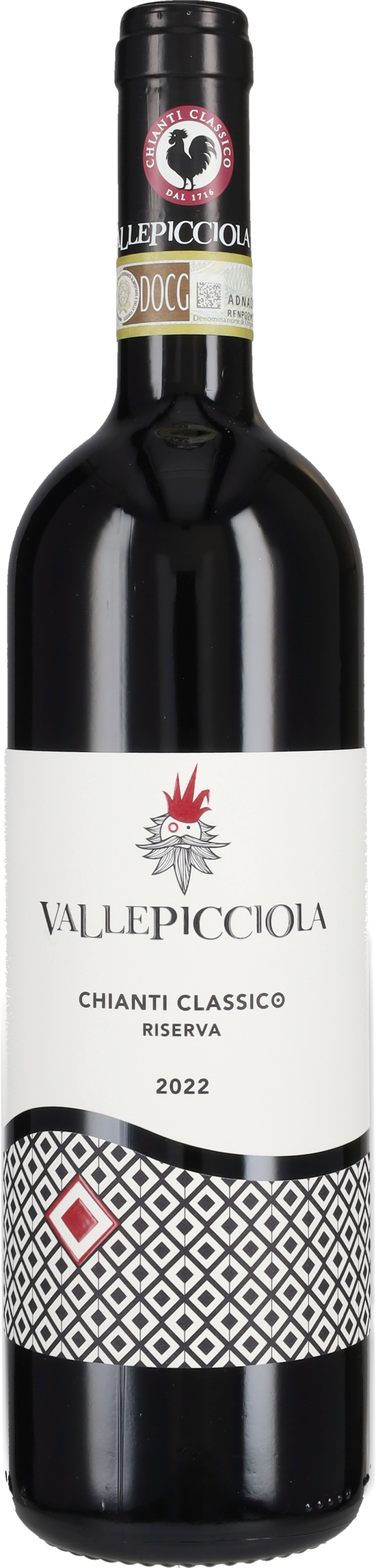
Chianti Classico Riserva Vallepicciola 2022Il Chianti Classico Riserva descrive il grande potenziale dell’uva Sangiovese in uno dei terroir tra i più vocati alla sua coltivazione di tutta la Toscana. L’olfatto è avvolto dalle tipiche note fruttate varietali, mentre in bocca si sprigiona un sorso concentrato, dotato di grande completezza di gusto. Un’etichetta con cui la cantina Vallepicciola si conferma come una delle realtà più interessanti del territorio, grazie anche all’appoggio di professionisti del calibro di Riccardo Cottarella, enologo di comprovata fama internazionale che supervisiona la produzione oramai da diversi vendemmie. Questa Riserva di Chianti Classico prende vita dalle uve in purezza di Sangiovese, coltivate dalla cantina Vallepicciola nei pressi del comune di Castelnuovo Berardenga a un’altezza di circa 440 metri sul livello del mare. Ci troviamo all’interno di un sottosuolo prettamente calcareo e argilloso. Il mosto fermenta in piccoli tini d’acciaio a una temperatura controllata, macerando per 15 giorni; la successiva malolattica si svolge invece in botti di rovere. Infine l’affinamento ha una durata compresa fra i 18 e i 20 mesi e si effettua sia in botti grandi di legno che in barrique. Il Riserva Chianti Classico si presenta alla vista con un colore rosso rubino concentrato, poco penetrabile alla vista. Elegante e delicata la traccia di profumi che viene disegnata al naso, dove sentori floreali si mescolano a tocchi di piccola frutta rossa e spezie. All’assaggio è di ottimo corpo, muscolare ed energico, con una trama tannica avvolgente che esalta un gusto dotato di ottima persistenza anche sul finale. Un rosso toscano perfetto per accompagnare i grandi piatti di carne e selvaggina, concedendosi un abbinamento davvero gratificante.23,00 £*Shipping: 48,00 £Secure redirect to the provider

-
Can you help me with a practice exercise on ser or estar in Spanish?
Of course! I'd be happy to help you with a practice exercise on ser or estar in Spanish. Please provide me with the exercise or the specific sentences you'd like to practice, and I can guide you through the process of determining whether to use ser or estar based on the context and the characteristics of each verb. Let me know how I can assist you further! **
-
What is the difference between ser and estar?
The main difference between ser and estar in Spanish is that ser is used to talk about permanent or lasting attributes, such as characteristics, professions, and relationships, while estar is used to talk about temporary states or conditions, such as emotions, locations, and physical conditions. Ser is also used to indicate origin, nationality, and time, while estar is used to indicate position or location. It is important to remember that ser is more permanent and estar is more temporary in nature. **
-
Can someone maybe tell me what the structural difference between the tripeptides Ser-Ala-Asp and Asp-Ala-Ser is?
The structural difference between the tripeptides Ser-Ala-Asp and Asp-Ala-Ser lies in the order of the amino acids within the peptide chain. In Ser-Ala-Asp, the amino acids are arranged in the order of serine, alanine, and aspartic acid, while in Asp-Ala-Ser, the order is reversed with aspartic acid, alanine, and serine. This difference in sequence can lead to variations in the overall shape, charge distribution, and potential interactions of the tripeptides with other molecules or proteins. **
-
Can someone maybe tell me what the structural difference is between the tripeptides Ser-Ala-Asp and Asp-Ala-Ser?
The structural difference between the tripeptides Ser-Ala-Asp and Asp-Ala-Ser lies in the order of the amino acids within the peptide chain. In Ser-Ala-Asp, the amino acids are arranged in the order of serine (Ser), alanine (Ala), and aspartic acid (Asp), while in Asp-Ala-Ser, the order is reversed with aspartic acid (Asp) followed by alanine (Ala) and then serine (Ser). This difference in sequence can lead to variations in the overall structure and function of the peptide. **
What is the difference between estar and ser in Spanish?
In Spanish, "estar" is used to indicate temporary states or conditions, such as location, emotions, or physical conditions. On the other hand, "ser" is used to indicate permanent characteristics or essential qualities of a person or thing, such as identity, origin, or inherent traits. While both verbs are used to express the idea of "to be," it is important to choose the correct one based on whether the characteristic is temporary or permanent. **
Why are ser and ir often conjugated similarly in Spanish?
Ser and ir are often conjugated similarly in Spanish because they both belong to the same category of verbs known as "irregular verbs." These verbs do not follow the regular conjugation patterns of most other verbs in the language. Additionally, both ser and ir are highly common and essential verbs in Spanish, so their irregular conjugations are widely used and familiar to Spanish speakers. This similarity in conjugation also makes it easier for learners to remember and use these important verbs correctly. **
Top-Angebote
Products related to Chianti-Classico-Riserva-Ser:
-
"""Mazzei Chianti Classico Riserva Ser Lapo 2020 Red Wine - Italy""""""Fresh, tannic, with aroma of berries, strong structure, earthy and intense taste. A savory nose of stone, soil and coffee pops with tart fruit aromas of cherries and blackberries. The palate brings sweeter, lighter cherry notes, with strawberry and..."27,97 $*Shipping: 0,00 $Secure redirect to the provider
-
Chianti Classico Riserva 'Ser Lapo' Castello di Fonterutoli - Mazzei 2Chianti Classico Riserva "Ser Lapo" from the Castello di Fonterutoli - Mazzei winery is a complex and elegant red wine produced at Fonterutoli in Castellina in Chianti, the heart of the Chianti Classico territory in Tuscany. This label is made from a blend of predominantly Sangiovese grapes plus a small portion of Merlot, from vineyards located on hillsides between 250 and 330 metres above sea level. The vines, which are between 10 and 30 years old, are trained using the spurred cordon method on medium-textured soils characterised by clayey-loamy soils with the presence of calcareous-arenarian skeleton. The winery is a historic entity founded in 1435, owner of the castle and the surrounding estate, which today extends over 650 hectares, 117 of which are vineyards.The "Ser Lapo" Chianti Classico Riserva of Castello Fonterutoli is produced from carefully selected grapes that are harvested between the beginning of September and the end of September, depending on the variety. Once the grapes reach the cellar, they are destemmed and gently crushed before undergoing alcoholic fermentation at a controlled temperature in steel containers with maceration on the skins for about 18 days. This is followed by racking with pressing of the skins, after which the wine is aged for at least 12 months in French barriques and tonneaux , half of which are new, before being bottled and ready for release.Chianti Classico "Ser Lapo" Riserva from Fonterutoli Mazzei presents itself to the eye with a beautiful, luminous ruby red colour with light garnet hues. On the nose, intense aromas of ripe fruit and berries appear, including black cherry, raspberry and currant, floral notes of dried flowers with details of undergrowth, then turning to spicy hints of oriental spices. In the mouth it is rich, intense, soft and enveloping, characterised by a pleasant freshness that gives persistence to the sip. This wine from the Mazzei Castello Fonterutoli winery is a red that perfectly expresses the terroir, endowed with great richness of flavour.21,00 £*Shipping: 48,00 £Secure redirect to the provider
-
"""Mazzei Chianti Classico Riserva Ser Lapo 2021 Red Wine - Italy""""""Fresh, tannic, with aroma of berries, strong structure, earthy and intense taste. Blend: 90% Sangiovese, 10% Merlot A solid, well-shaped, focused and vibrant riserva with aromas of wild currants, Morello cherries, warm herbs and baking spices. It’s..."32,97 $*Shipping: 0,00 $Secure redirect to the provider
-
Chianti Classico Riserva Brancaia 2022The Chianti Classico Riserva by Brancaia is configured as an elegant and deep interpretation produced with the best Sangiovese grapes cultivated by the estate, to which a smaller percentage of Merlot is added, a variety that brings body and softness. This label, released for the first time with the 1982 vintage, is made in the estates of Castellina in Chianti and Radda in Chianti, historic municipalities of the Gallo Nero. Brancaia Chianti Classico Riserva originates from a blend of Sangiovese (80%) and Merlot (20%), varieties grown on medium-textured soils rich in skeleton, between 230 and 400 meters above sea level. The rows, exposed to the south and southwest, benefit from the characteristic continental climate with cold winters and hot summers. Once the grapes have reached their respective optimal ripeness, manual harvesting is carried out, followed by alcoholic fermentation in stainless steel tanks, separated for the two varieties, with about 20 days of maceration on the skins. Subsequently, the mass of Sangiovese matures in tonneau while the Merlot ages in barrique, all for a period of 16 months that precedes the blending and the further resting of 8 months in the bottle. In the glass, the Chianti Classico Riserva Brancaia displays an intense and bright ruby red cloak. Vivid and complex is the olfactory range, defined by aromas of red fruits, wildflowers, aromatic herbs, tilled earth, and tar that meet seductive perceptions of leather and vanilla. Intense, soft, and elegant taste development, with sweet and ripe tannins that lead to a fresh and flavorful epilogue. A Chianti Classico endowed with exceptional longevity, which needs to be paired with dishes of a certain structure such as rich preparations based on red meat or game.28,00 £*Shipping: 48,00 £Secure redirect to the provider
-
Is a 12-year-old Chianti still drinkable?
Yes, a 12-year-old Chianti can still be drinkable, especially if it has been stored properly in a cool, dark place. Chianti is a red wine that is known for its aging potential, and many Chianti wines can continue to develop and improve in flavor over time. However, it's important to note that not all Chianti wines are meant for long-term aging, so it's best to consult with a wine expert or sommelier to determine if a specific bottle of Chianti is still drinkable after 12 years. **
-
What are your tips for the German Classico?
To enjoy the German Classico, make sure to immerse yourself in the rich history and intense rivalry between Bayern Munich and Borussia Dortmund. Learn about the key players on both teams and their playing styles to appreciate the tactical battle on the field. Additionally, try to watch the match with friends or fellow fans to enhance the experience with lively discussions and friendly banter. Lastly, don't forget to savor the passion and excitement of one of the most anticipated matches in German football. **
-
Can you help me with a practice exercise on ser or estar in Spanish?
Of course! I'd be happy to help you with a practice exercise on ser or estar in Spanish. Please provide me with the exercise or the specific sentences you'd like to practice, and I can guide you through the process of determining whether to use ser or estar based on the context and the characteristics of each verb. Let me know how I can assist you further! **
-
What is the difference between ser and estar?
The main difference between ser and estar in Spanish is that ser is used to talk about permanent or lasting attributes, such as characteristics, professions, and relationships, while estar is used to talk about temporary states or conditions, such as emotions, locations, and physical conditions. Ser is also used to indicate origin, nationality, and time, while estar is used to indicate position or location. It is important to remember that ser is more permanent and estar is more temporary in nature. **
Similar search terms for Chianti-Classico-Riserva-Ser
-
Chianti Classico Riserva Riecine 2022The Chianti Classico Riserva from Riecine is an elegant and intense version of this extraordinary Tuscan wine. It is the perfect synthesis between the beautiful hilly area of Gaiole in Chianti and Sangiovese: the red grape variety that has dwelled in these lands for centuries and is its authentic and best interpreter. It is a label of particular value, positioned in the elite of the denomination. The high-quality grapes and aging in wood contribute to give a mature and harmonious face, capable of preserving intact the fragrance and immediacy of the classic fruity notes of Sangiovese. The Chianti Riserva Classico wine is born in one of the most interesting and renowned wineries in the Classic Chianti area. Riecine has been a reference point for the reds of Gaiole for over 40 years, for its ability to produce labels that are not only of excellent quality but also faithful expressions of the character of the territory. The vineyards cover a total of about fifteen hectares, divided into various plots with different soils and microclimates among them, that are vinified separately, in order to have the possibility to choose later only the parcels that have expressed the best wines of the vintage. The reds from Reicine possess a marked personality. They highlight excellent work in the vineyard and a minimalist approach in the cellar, which translates into a clear and transparent fidelity to the territory. The fermentations take place in concrete tanks using only indigenous yeasts and a maceration on the skins for a couple of weeks. Before bottling, the wine matures for 20 months in large oak barrels and completes the aging with a few months in the bottle.The Chianti Riserva Riecine is a bottle to reserve for a special evening and to bring to the table to accompany a Florentine steak, a tagliata, or a roast. The grapes come from a selection of the best vineyards of the estate cultivated at about 450 meters above sea level on soils composed of clay and limestone. It is a deep ruby red glass with slight garnet reflections, revealing aromas of black currant, cherry, and berries,47,00 £*Shipping: 48,00 £Secure redirect to the provider
-
Chianti Classico Riserva Vallepicciola 2022Il Chianti Classico Riserva descrive il grande potenziale dell’uva Sangiovese in uno dei terroir tra i più vocati alla sua coltivazione di tutta la Toscana. L’olfatto è avvolto dalle tipiche note fruttate varietali, mentre in bocca si sprigiona un sorso concentrato, dotato di grande completezza di gusto. Un’etichetta con cui la cantina Vallepicciola si conferma come una delle realtà più interessanti del territorio, grazie anche all’appoggio di professionisti del calibro di Riccardo Cottarella, enologo di comprovata fama internazionale che supervisiona la produzione oramai da diversi vendemmie. Questa Riserva di Chianti Classico prende vita dalle uve in purezza di Sangiovese, coltivate dalla cantina Vallepicciola nei pressi del comune di Castelnuovo Berardenga a un’altezza di circa 440 metri sul livello del mare. Ci troviamo all’interno di un sottosuolo prettamente calcareo e argilloso. Il mosto fermenta in piccoli tini d’acciaio a una temperatura controllata, macerando per 15 giorni; la successiva malolattica si svolge invece in botti di rovere. Infine l’affinamento ha una durata compresa fra i 18 e i 20 mesi e si effettua sia in botti grandi di legno che in barrique. Il Riserva Chianti Classico si presenta alla vista con un colore rosso rubino concentrato, poco penetrabile alla vista. Elegante e delicata la traccia di profumi che viene disegnata al naso, dove sentori floreali si mescolano a tocchi di piccola frutta rossa e spezie. All’assaggio è di ottimo corpo, muscolare ed energico, con una trama tannica avvolgente che esalta un gusto dotato di ottima persistenza anche sul finale. Un rosso toscano perfetto per accompagnare i grandi piatti di carne e selvaggina, concedendosi un abbinamento davvero gratificante.23,00 £*Shipping: 48,00 £Secure redirect to the provider
-
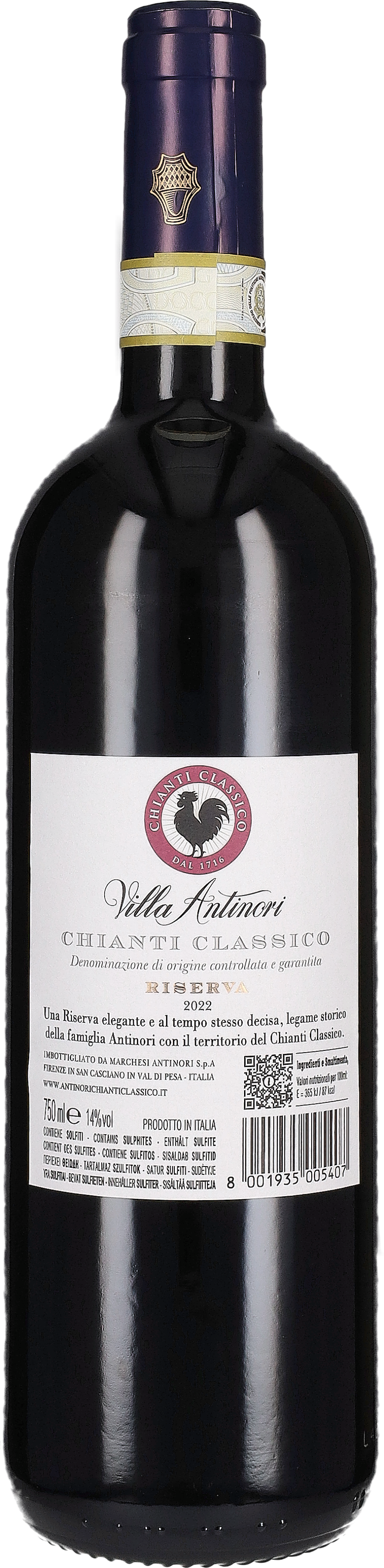
Chianti Classico Riserva 'Villa Antinori' 2023The Chianti Classico Riserva "Villa Antinori" is one of the most famous representatives of the Chianti tradition, a splendid fusion of finesse and classicism. A historic wine par excellence, inextricably linked to the history of the illustrious Tuscan denomination and to that of its almost millenary producers, namely the Antinori family. The "Villa Antinori" was born in 1928, immediately establishing itself as a benchmark for its type. The deep bond between man and his native land has driven Pietro Antinori, the first winemaker of the family in 1385, and his successors, to produce wines that are liquid testimony of the place. After interrupting the production of Chianti for about ten years, the Antinori family decided to give it a new shine, reintroducing it to the market coinciding with the opening of the new winery located in the Chianti Classico area. The blend is predominantly made up of Sangiovese, with a small addition of Cabernet Sauvignon, aimed at giving the wine softness and structure. It ages in second and third passage barriques, enriching its aromatic range with notes toasted and sweet. The Riserva "Villa Antinori" presents itself with a sparkling ruby color that shifts towards garnet. On the nose, it immediately paints a dark-hued picture made of berries intertwined with bursts of coffee and vanilla. The sip, decisive and alluring, immediately captivates due to its caressing texture. It deserves to be enjoyed with rare steaks and regional preparations like peposo, as well as well-seasoned first courses. A piece of history that has managed to renew itself, continuing to surprise with class and elegance.22,00 £*Shipping: 48,00 £Secure redirect to the provider
-
Can someone maybe tell me what the structural difference between the tripeptides Ser-Ala-Asp and Asp-Ala-Ser is?
The structural difference between the tripeptides Ser-Ala-Asp and Asp-Ala-Ser lies in the order of the amino acids within the peptide chain. In Ser-Ala-Asp, the amino acids are arranged in the order of serine, alanine, and aspartic acid, while in Asp-Ala-Ser, the order is reversed with aspartic acid, alanine, and serine. This difference in sequence can lead to variations in the overall shape, charge distribution, and potential interactions of the tripeptides with other molecules or proteins. **
-
Can someone maybe tell me what the structural difference is between the tripeptides Ser-Ala-Asp and Asp-Ala-Ser?
The structural difference between the tripeptides Ser-Ala-Asp and Asp-Ala-Ser lies in the order of the amino acids within the peptide chain. In Ser-Ala-Asp, the amino acids are arranged in the order of serine (Ser), alanine (Ala), and aspartic acid (Asp), while in Asp-Ala-Ser, the order is reversed with aspartic acid (Asp) followed by alanine (Ala) and then serine (Ser). This difference in sequence can lead to variations in the overall structure and function of the peptide. **
-
What is the difference between estar and ser in Spanish?
In Spanish, "estar" is used to indicate temporary states or conditions, such as location, emotions, or physical conditions. On the other hand, "ser" is used to indicate permanent characteristics or essential qualities of a person or thing, such as identity, origin, or inherent traits. While both verbs are used to express the idea of "to be," it is important to choose the correct one based on whether the characteristic is temporary or permanent. **
-
Why are ser and ir often conjugated similarly in Spanish?
Ser and ir are often conjugated similarly in Spanish because they both belong to the same category of verbs known as "irregular verbs." These verbs do not follow the regular conjugation patterns of most other verbs in the language. Additionally, both ser and ir are highly common and essential verbs in Spanish, so their irregular conjugations are widely used and familiar to Spanish speakers. This similarity in conjugation also makes it easier for learners to remember and use these important verbs correctly. **
* All prices are inclusive of VAT and, if applicable, plus shipping costs. The offer information is based on the details provided by the respective shop and is updated through automated processes. Real-time updates do not occur, so deviations can occur in individual cases. ** Note: Parts of this content were created by AI.